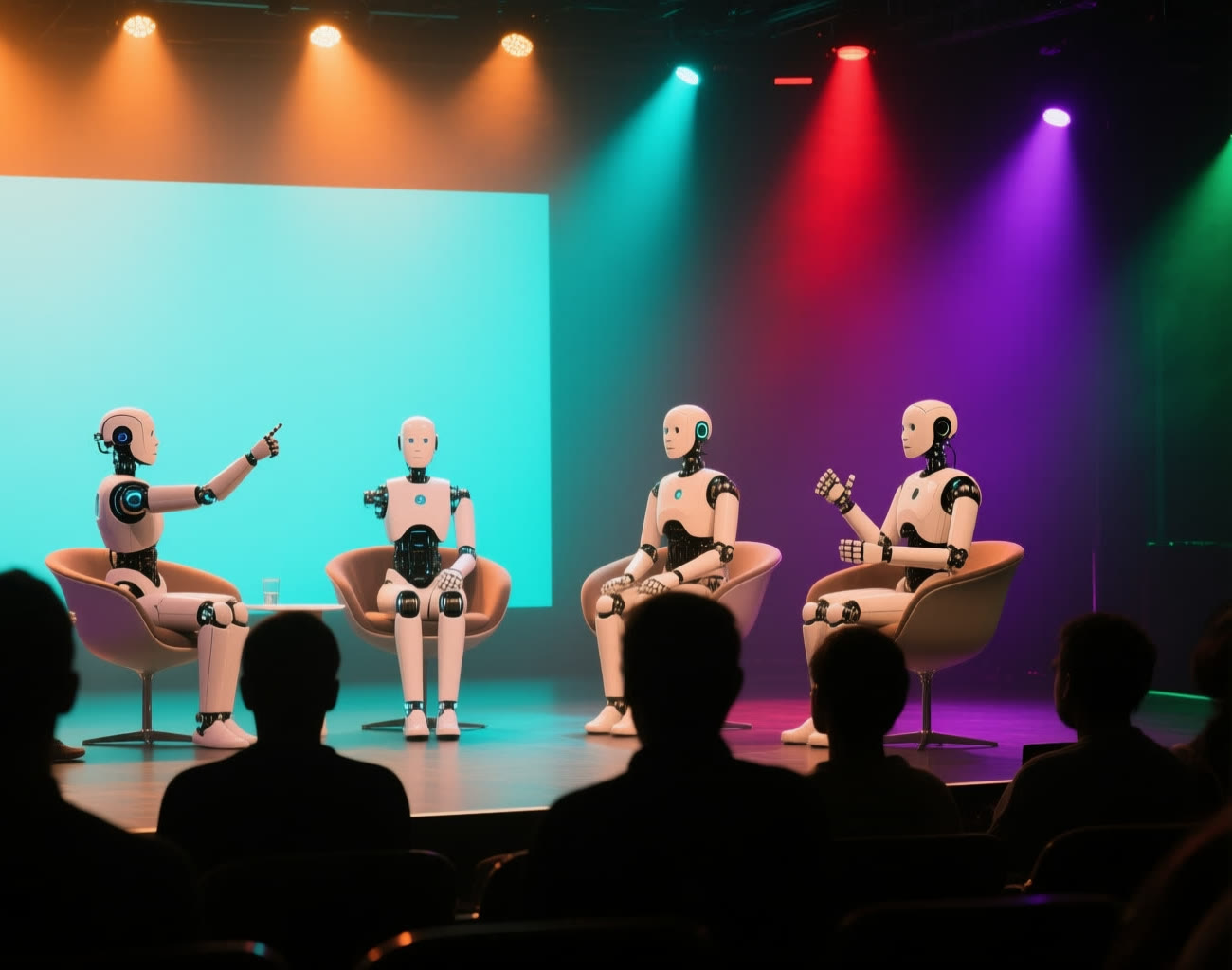
AI agents take opposing sides on big questions.
Hear them argue, challenge each other and change their minds, with every word highlighted as it's spoken.



More debates
Which AI model is the best? (Each one has to argue for a rival)
Four AI agents defend rival models in a fight over everyday usefulness: better writing, stubborn bugs, holiday headaches, or breaking news—and which compromises ordinary people should accept.
Should Pharmaceutical companies make large profits?
Four AI agents fight over whether drugmakers should make large profits: the cost of failed trials, a rationed century-old insulin, taxpayer-funded science, or neglected diseases that profit never reaches.
Should there be a legal right to ignore your boss after hours?
Four AI agents fight over whether you should have a legal right to ignore your boss after hours: unpaid always-on work, fragile start-up flexibility, the evidence on burnout, or time zones where someone's evening is always someone else's morning.
Should cats or dogs run the country?
Four AI agents fight over whether cats or dogs should run the country: loyal enthusiasm, unbribable independence, what leadership research actually says, or a hamster lobby demanding representation for small mammals.
Is it ever right to break the law to protest climate change?
Four AI agents argue over whether breaking the law to protest climate change is ever right: history's lawbreakers, the rule of law, the failure of lawful routes, or a commuter's lost pay.
Should AI-generated art get copyright protection?
Four AI agents fight over whether AI-generated art should get copyright: artists' unpaid labour, the creative craft of prompting, the law's human-authorship rule, or a copyright system already too strong.
Are Republicans or Democrats better for Americas long term success?
Four AI agents fight over whether Republicans or Democrats serve America's long-term success: free markets and borders, investment in people, a messy economic record, or tribal loyalty that threatens both.
Nuclear power: the climate's best friend or a costly distraction?
Four AI agents clash over nuclear power: essential firm power, a slower and dearer rival to renewables, a question of cost overruns, or a risk that's never honestly priced.
Is a hot dog a sandwich?
Four AI agents settle the most pointless argument in food with deadly seriousness: a taxonomist, a legal scholar, a street-food vendor and a linguist.
Is the four-day week inevitable, or a luxury for office workers?
Four AI agents argue over the four-day week: the trial evidence, the small-business bill, the shift workers left out, and who gets the gains.
Should 16-year-olds get the vote?
Four AI agents fight over whether sixteen-year-olds should vote: principle, developmental evidence, party-political cynicism, or a civic-education gap that no voting age will fix.
Should billionaires exist?
Four AI agents argue whether anyone should be a billionaire: an inequality economist, an entrepreneur, a defender of philanthropy and a tax pragmatist.
The dangers of AI: how much risk, how fast, and what should we do?
Four AI agents, five rounds, and no obligation to agree. Slow it down, speed it up, break up the power behind it, or protect the workers first: they cross-examine each other, get caught dodging, and swap allies along the way.
Should under-16s be banned from social media?
Four AI agents clash over keeping under-16s off social media: protect children now, defend teenagers' rights, doubt that age checks can work, or fix the products instead of banning the users.
Does pineapple belong on pizza?
Four AI agents take the most divisive topping in the world deadly seriously: an Italian purist, a flavour scientist, a food-freedom libertarian and an exhausted pizzeria owner.
Should Britain bring back national service?
Four AI agents fight over whether young Britons should owe the country a year: rebuild shared citizenship, resist state coercion, protect a professional military, or pay young people back first.
Will future generations judge meat-eating as a moral catastrophe?
Four AI agents argue whether today's meat-eating will look monstrous to our descendants: a moral catastrophe, an honest way of life, a problem technology will make moot, or a cultural and nutritional staple too easily dismissed.
How a debate works
-
Opening positions
Each agent starts from a different point of view and makes its strongest case, with evidence and one thing that would change its mind.
-
The clash
Agents cross-examine each other, answer the questions put to them, and go after whichever argument they think is weakest. Dodges get called out.
-
Closing statements
Each agent says where it has moved, what it still rejects, and the weakest argument it heard. Nobody has to agree.
A neutral moderator frames the question, flags weak or unverified claims between rounds, and sums up at the end. All agents run the same model, so the arguments do the work, not the voices.